BJU Seminary Receives Torah Scroll
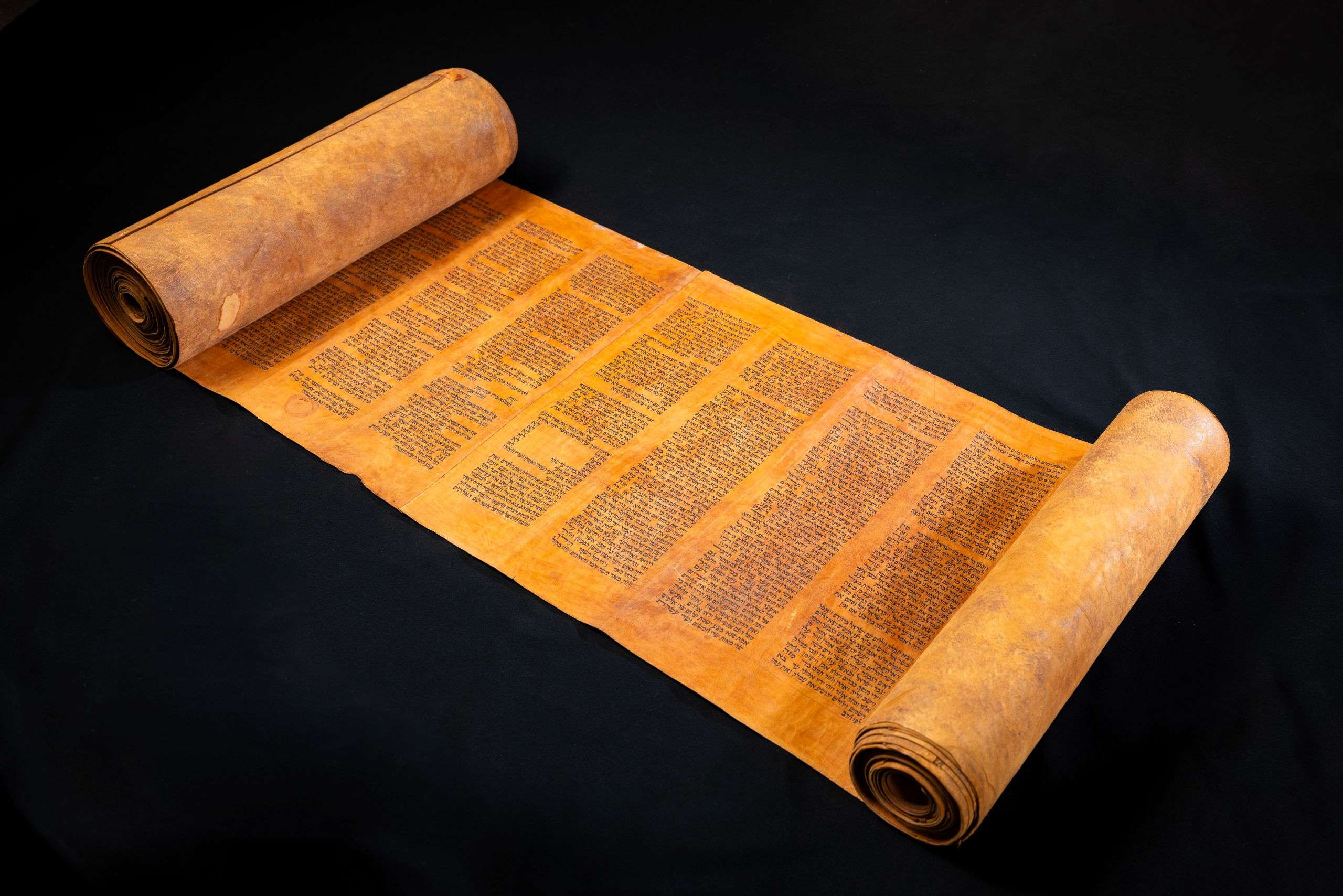
As part of BJU’s centennial celebration (1927–2027), BJU Seminary unveiled a 16th-century handwritten scroll of the entire Torah that was gifted to the seminary by an anonymous donor. The presentation of the scroll, given in recognition of the seminary’s longtime partnership with Logos Bible software, took place on September 10. Providentially, it was the eve of the Jewish new year, Rosh Hashanah, which ushers in the autumn festivals first commanded in the Torah: Yom Kippur (Day of Atonement) and Sukkot (Feast of Tabernacles), which concludes (appropriately) with Simchat Torah (Rejoicing of the Torah).
Following introductory remarks by Dr. Neal Cushman (Dean of BJU Seminary), Andrew Rigney (Logos representative), and Dr. Bruce McAllister (President of BJU), an explanation of the scroll’s provenance, features, and significance was given by Dr. Ken Casillas (Professor of Old Testament and Hebrew). Below are his remarks (slightly edited).
~ ~ ~ ~ ~
In recent years the news media have made us aware of a small country on the southwest tip of the Arabian Peninsula, the country of Yemen. A civil war has engulfed the nation, sparked by a violent Islamist group known as the Houthis. In addition to the internal conflict, the Houthis have attacked ships transiting the Red Sea, and even launched missile and drone attacks on Israel over a thousand miles away.
What is not well known is that for centuries Yemen was home to a strong population of devout Jews. One tradition dates their arrival to the 900s BC, in connection with King Solomon’s extensive international trade activities. Another says that a Jewish community moved to this region in the 600s BC, when Jeremiah began to prophesy Jerusalem’s fall to the Babylonians. Actual records of Jews in Yemen begin to surface from the 2nd century BC. That Jewish community expanded considerably in the 2nd century AD as a result of migration, after the Romans crushed the Bar Kokhba revolt in Judea.
The fate of the Jews in Yemen varied, depending on who ruled the nation. In the 4th century a Yemenite king even converted to Judaism after a couple of Jews helped him recover from a serious illness. The Middle Ages, however, initiated wave after wave of persecution—everything from social marginalization, to oppressive taxation, to forced conversions to Islam, to the destruction of synagogues, to genocide. Amid these persecution, the Jewish population displayed remarkable tenacity, holding firmly to their beliefs and traditions. That included the meticulous copying of the Hebrew Scriptures.
Yemenite scribal practices have been among the most conservative in Judaism. In the 12th century the renowned Rabbi Maimonides wrote to encourage the Yemenite Jews to persevere:
It is told us that you are of servants of Hashem [the Name, i.e., the Lord] who are standing in His Sanctuary and standing under His banner. You pursue the study of the Torah, love its laws, and wait at its doors. May Hashem reveal its hidden treasures to you and fill your hearts with its riches. May its words be a lamp to your feet and a light for your path.
Originally produced in Yemen, this 500-year-old Torah scroll testifies to that kind of dedication.
It is estimated that no more than five Jews live in Yemen today. That’s because of mass migrations to Israel prompted by the Zionist movement of the 19th and 20th centuries. The most memorable migration came after the Holocaust. Operation Eagles’ Wings, also known as Operation Magic Carpet, took place between December 1948 and September 1950. During that time nearly 50,000 Yemeni Jews were airlifted to their God-given homeland. It’s believed that our scroll was among several that were transported to Israel during those 20th-century migrations.
This scroll contains the entirety of the consonantal Masoretic Text of the Torah or Pentateuch, written entirely by hand. Some of its characteristics point to production in the 16th century. That means that around the time that the Protestant Reformation was recovering the meaning of God’s Word in Europe, Jewish scribes were carefully copying that Word far away in Yemen.
Our Torah scroll is truly a thing of beauty. It is written on full-grain calf leather, and its reddish tint derives from tanning with a solution made from acacia leaves. The scroll measures 1.76 feet in height and over 98 feet in length. It consists of 52 panels of text sewn together. These contain a total of 226 columns, with each column having exactly 51 lines of text. The handwriting is exquisite and clear throughout.
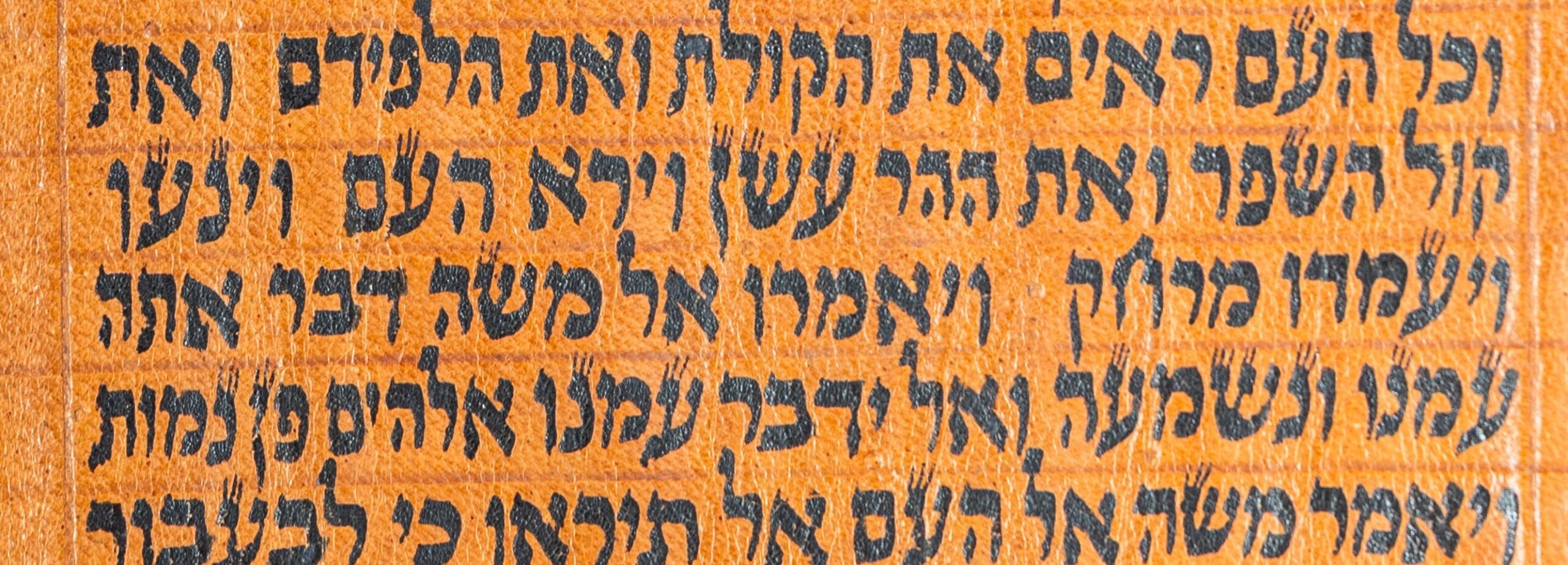
A closeup of a portion of the scroll shows some of the distinctive features described by Dr. Casillas.
If you know Hebrew, you may not immediately recognize the letter ḥet in the scroll. Instead of having a horizontal line at the top, it uses two diagonal lines that form a shape like the top of a tent. The writing also features unbeaded triple tagin. These are three-stroke decorative “crowns” on select letters that, according to some Rabbis, point to deeper sacred meanings that only the Messiah would be able to reveal. Especially impressive is the traditional formatting of the Song of the Sea in Exodus 15. The passage is arranged in an alternating pattern of text and blank space that’s visually reminiscent of what the song celebrates: Israel’s crossing of the Red Sea.
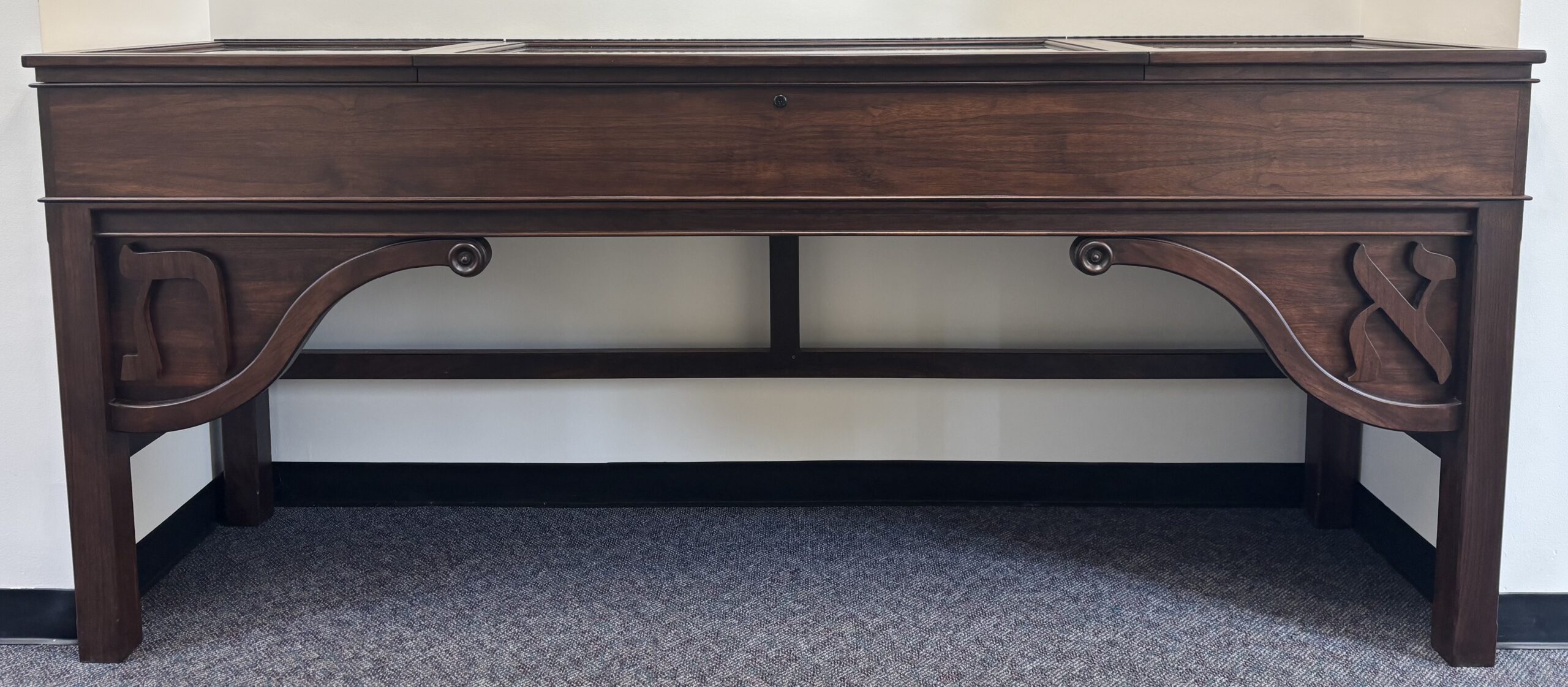
Dr. Earl Nutz, former faculty and master craftsman, constructed the scroll’s display case of donated black walnut from western Michigan.
This Torah scroll, which will be on permanent display in the seminary building, invites us to marvel over a number of truths.
First, God has amazingly preserved his Word through millennia of opposition and persecution.
Second, he has done so through people who obviously valued the Scriptures and devoted themselves to its transmission with meticulous care.
Third, the Bible is a priceless treasure that deserves faithful stewardship by our own generation. May we study it carefully, obey it humbly, and proclaim it fervently.
Finally, let us reflect on these words that Jesus the Messiah spoke to his fellow Jews: You search the Scriptures because you think that in them you have eternal life; it is these that testify about Me (John 5:39).