A World Turned Upside Down
We celebrate the 250th anniversary of the day when the Second Continental Congress adopted and published the Declaration of Independence, severing our nation’s tie to England. July 4, 1776.
The following month, England landed 30,000 British troops and Hessian soldiers in New York to attack George Washington’s army. After months of fighting and staggering losses, George Washington and his men were forced to retreat for miles and miles, while the British army pursued them with confidence that this war would be over in a hurry, along with the notion of the rebel nation that their “declaration” had called the United States of America.
The retreat ended with Washington’s army on the far side of the Delaware River, their supplies depleted, the soldiers exhausted, a winter storm cutting through them with blinding sleet, many of the soldiers with no shoes or with rags tied onto their feet to find warmth in the raw cold. On the other side of the Delaware River the a Hessian garrison was having a party—drinking and dancing around their warm fires.
This was the setting for Washington’s famous surprise attack. He got his army over the Delaware in secret, one boatload at a time, each boat in danger of capsizing or being swept down river. But they made it across, surprised the unsuspecting army, and defeated the garrison, taking over a thousand prisoners. This was the battle of Trenton. And this victory meant that the Colonial army gained food and supplies.
After that, Washington recrossed the Delaware, and crossed again a week later, surprising and defeating the British at the Battle of Princeton.
And over the next five years or so, the entire nation would go through much turmoil and hardship fighting for independence. Washington’s army, outnumbered, short on supplies and weaponry, suffered some crushing defeats.
But there were also many surprise victories, like Trenton and Princeton. One of the others was the Battle of Cowpens, right here in upstate South Carolina. On that battlefield, a shabby army of American underdogs completely destroyed an elite British force who were there to wipe out the army in South Carolina.
When the British advanced, the American army tricked them into thinking they were retreating, only to draw them into a trap where they faced the main firing line in front, another company of soldiers from one side, and the calvary from the other.
The battle literally lasted only 50 minutes. 800–900 British soldiers were killed, wounded, or captured, while the Americans lost only 12 men killed and about 60 wounded.
These kinds of surprising upsets stunned the British army again and again. They just couldn’t believe these less sophisticated, inexperienced rebels could defeat them!
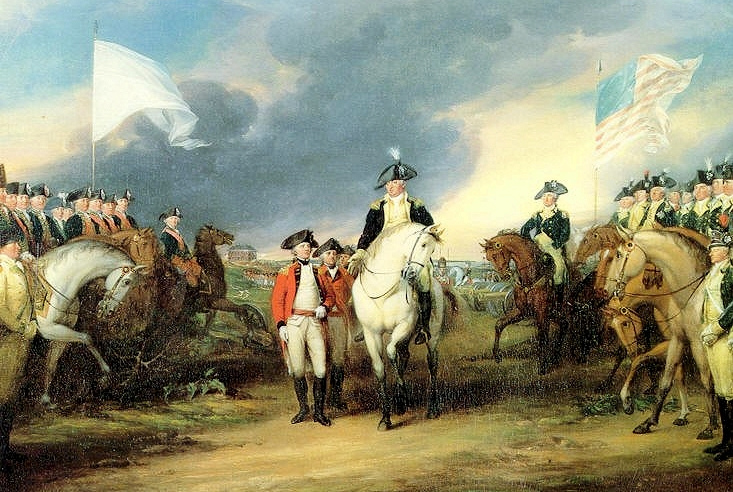
Nine months after the Battle of Cowpens, the British General Cornwallis, in disbelief, commanded his men to lay down arms at Yorktown, Virginia, in October of 1781, ending the last of the major fighting of the war. And it is said that, as the British military marched forward to surrender, their fife and drum band played a mocking tune known as “The World Turned Upside Down.”
If buttercups buzz’d after the bee,
If boats were on land, churches on sea,
If ponies rode men and if grass ate the cows,
And cats should be chased into holes by the mouse,
If summer were spring and the other way round,
Then all the world would be upside down.
Because, in their minds, this shouldn’t be happening. The Americans should be surrendering to them! It was as upside down as having summer before spring.
The British military was a polished, global superpower. The Continental Army was a mix of farmers, teenagers, and tradesmen. They didn’t even have matching uniforms, or proper shoes, or standard weapons. They were not considered to be a military threat.
Yet against all expectations, the Americans prevailed over the greater imperial power, because they were they were driven by promise of freedom from the tyranny of the British crown, and, among other liberties, the right to govern themselves under God, and to worship him freely. And God used their stunning victory to birth a nation that provided these very blessings.
A World Right Side Up
But the American Revolution is not the most amazing event in world history that turned the world upside down. Far from it.
The greatest example of the world being turned upside down is illustrated by the faithful witness of a few other ragtag men who entered the city of Thessalonica in Acts 17—the apostle Paul, Silas, and Timothy. As far as we know, only Paul was formally educated. Timothy was still a very young man, quite possibly even in his late teens. Paul and Silas had been beaten with rods in Philippi about a week earlier and were no doubt still limping along and nursing their wounds.
And yet, when they preached the gospel, proclaiming that a crucified and risen Jew from Galilee was really the king and not Caesar this is what happened.
Acts 17:4 says,
And some of them were persuaded and joined Paul and, as did a great many of the devout Greeks and not a few of the leading women.
That is quite a mix of those who heard the gospel and were saved. Jews from the local synagogue, God-fearing Gentiles, and prominent women in Thessalonica.
But then, verse 5 says,
The Jews were jealous, and taking some wicked men of the rabble, they formed a mob, set the city in an uproar, and attacked the house of Jason, seeking to bring them out to the crowd. 6And when they could not find them, they dragged Jason and some of the brothers before the city authorities, shouting, “These men who have turned the world upside down have come here also.”
Turned the world upside down! How could a few men possibly have any impact like that upon a large and important city like Thessalonica?
Because, of course, it wasn’t that these men had turned the world upside down. It’s that the Lord Jesus was using them as his messengers to turn the world right side up. These were ordinary men like the original twelve disciples. Only, God was using these ordinary men in extraordinary ways. They were proclaiming a gospel that liberated men and women from the tyranny of sin and death.
For that is what we are called to do. Christ, our captain, has already drawn the battle lines between life and death, heaven and hell, salvation and judgment. The gospel is the call to all people everywhere to choose sides.
Our Marching Orders
“Go therefore and make disciples of all nations…” (Matt. 28:19).
Like Washington’s army, we often feel small, weak, under-equipped, and unequal to the task before us. We wonder what difference one conversation, one invitation, one act of faithful witness could possibly make in a world so opposed to the truth. But these are precisely the kinds of people the Lord has always chosen to use.
Through the gospel, Jesus has given his church its own declaration of freedom—not from an earthly king, but from the tyranny of sin and death. He also commissions ordinary men and women to carry that message to every nation.
He chose fishermen, tax collectors, tradesmen, persecuted missionaries, and unnamed believers. He chooses ordinary Christians today. Not because we are impressive, but because when extraordinary victories are won through ordinary people, there is only one explanation: God did it. As Paul reminds us, “God chose what is weak in the world to shame the strong … so that no human being might boast in the presence of God” (1 Cor. 1:27–29).
The freedoms we celebrate on Independence Day did not preserve themselves. They were won through sacrifice and sustained by generations willing to stand for what they believed.
Neither did the gospel’s influence in our nation appear by accident. It spread because countless ordinary believers took Christ’s commission seriously. Farmers and merchants, mothers and fathers, pastors and schoolteachers, factory workers and students faithfully proclaimed the gospel in their homes, churches, neighborhoods, and communities. Most of their names have been forgotten by history. But God used each one.
The question is not whether God can still turn the world right side up through ordinary people. He can. He always has. The question is whether we will take up our marching orders and be used by him to continue the advance of the gospel in our nation.