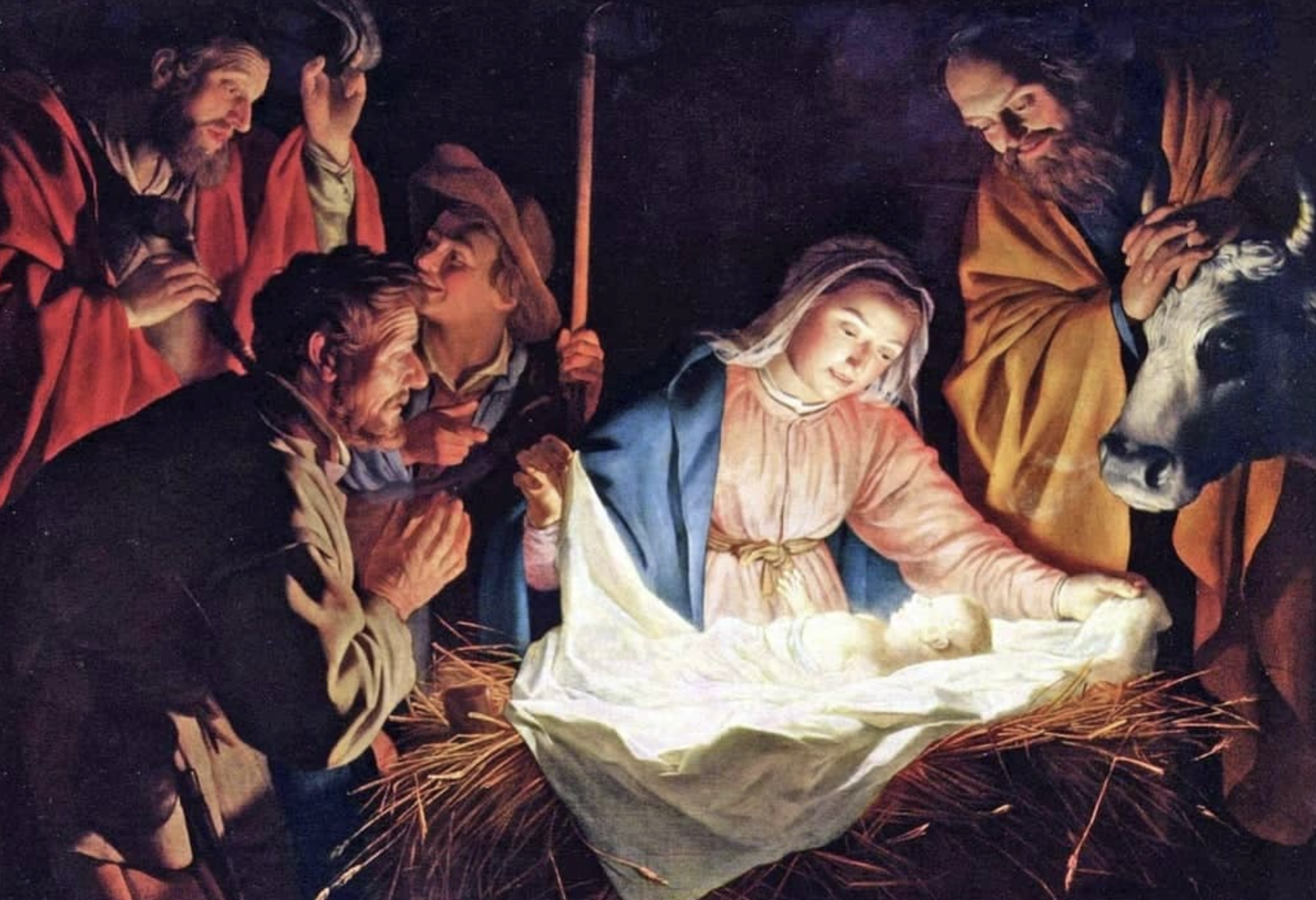
whose child is this?
Each December, we pastors find our month of sermons tethered to the theme of Christmas. I’m not begrudging that reality—the incarnation of the Son of God and his mission to rescue lost humanity is one of the most glorious truths to proclaim. But after preaching the birth narratives of Matthew and Luke, various messianic prophecies, John 1:1–18, and a number of standard texts from the epistles (e.g., Gal 4:4–5; Phil 2:5–11; 2 Cor 8:9; Heb 2:5–18), pastors are forced to either become more creative in finding new texts or start repeating sermons. So, in preaching regularly through the Gospel of Matthew this year, I was delighted to discover a great Christmas text right under my nose.
In Matthew 22, the Pharisees and Sadducees unsuccessfully confront Jesus with a series of questions designed to humiliate and discredit him in the eyes of the people (Matt 22:15–40). But at the climax of this coordinated attack, Jesus turns the tables on them with a question of his own.
Now while the Pharisees were gathered together, Jesus asked them a question, 42 saying, “What do you think about the Christ? Whose son is he?” They said to him, “The son of David.” 43 He said to them, “How is it then that David, in the Spirit, calls him Lord, saying,
44 “‘The Lord said to my Lord,
“Sit at my right hand,
until I put your enemies under your feet”’?45 If then David calls him Lord, how is he his son?” 46 And no one was able to answer him a word, nor from that day did anyone dare to ask him any more questions.
This is a great Christmas text because it helps us explore the identity of Jesus from his human birth to his glorious exaltation as the incarnate Son of God.
The crucial question posed by Jesus is, “Whose son is the Messiah?” As seen in Jesus’s exchange with the Pharisees, there are four ways that this question may be truthfully answered with respect to Jesus’s own identity.
Jesus is a Son of David
First, the question may be answered according to the basic level of Jesus’s ancestry: he is a son of David, descended from David’s royal line. Even if the Pharisees did not believe that Jesus himself was the Messiah, when asked about the Messiah’s origin they correctly answer: The Messiah, whoever he is, will come from the royal line of David.
This heritage is carefully delineated in Matthew’s Gospel that begins with the words, “The book of the genealogy of Jesus Christ, the son of David, the son of Abraham” (Matt 1:1). The genealogy that follows (1:2–17) focuses primarily on the royal descent of Jesus from David (1:6, 17) and the angel who appears to Joseph highlights Jesus’s lineage by referring to Joseph as the “son of David” (1:20).
Even Jesus’s fiercest critics could not deny that he was born into David’s line. When the census was ordered by Caesar Augustus, requiring everyone to be registered in his ancestral town, Joseph obediently traveled with Mary to Bethlehem, “because he was of the house and lineage of David” (Luke 2:1–5). In Nazareth, Jesus was known simply as “the carpenter’s son” (Matt 13:55), but in a culture that kept meticulous genealogical records, that title carried Joseph’s lineage. Because Jesus was identified with Joseph’s family, people naturally assumed that he and his brothers shared Joseph’s Davidic heritage.
Jesus is the Son of David
Of course, being descended from an ancient king does not make a person himself great. To all appearances, Jesus looked like any other human being.
But to those who had embraced Jesus and believed in him, he was not merely a son of David, but the son of David, God’s actual Messiah, their promised King.
For generations the Jewish people had been anticipating their Messiah, the one who would deliver them from their enemies and restore to them the miraculous kingdom God had promised. God’s promise to send this anointed one from David’s line went back to the prophet Nathan, who told David, “[Y]our house and your kingdom shall be made sure forever before me. Your throne shall be established forever” (2 Sam 7:16). Later, as the nation of Israel splintered and became steeped in idolatry, heading for God’s judgment, the prophets began to give details about this coming King and his inevitable reign (Isa 9:1–7; 7:13–14; 11:1–10; Jer 23:1–6; 33:14–22; Ezek 34:23–24; 37:24–28; Hos 3:4–5; Mic 5:2–5).
Jeremiah 33 is especially salient, blossoming with hope:
“Behold, the days are coming, declares the Lord, when I will fulfill the promise I made to the house of Israel and the house of Judah. 15 In those days and at that time I will cause a righteous Branch to spring up for David, and he shall execute justice and righteousness in the land. 16 In those days Judah will be saved, and Jerusalem will dwell securely. And this is the name by which it will be called: ‘The Lord is our righteousness.’
17 “For thus says the Lord: David shall never lack a man to sit on the throne of the house of Israel … (Jer 33:14–17).
The Lord, Jehovah, also promised through Jeremiah that the sun and moon would sooner stop rising in their cycles before he would break his covenant with David (33:20–21).
The fulfillment of this covenant promise in Jesus is the focus of the evangelists as they narrate the Gospels. The angel assures Joseph, “[Mary] will bear a son, and you shall call his name Jesus, for he will save his people from their sins” (Matt 1:21). To highlight this royal birth, Matthew tells how Jesus is visited by three mysterious dignitaries from the east who worship him with kingly gifts (Matt 2:1–11). When the people heard Jesus’s teaching and saw his miracles, many of them rightfully identified him as “the son of David” (esp. Matt 9:27; 12:23; 15:22; 20:30–31; 21:9, 15). They were not merely hailing him as a son of David, but the son of David—the promised one who would save them.
Jesus is the Lord of David
But there is yet a more profound way to answer the question, “Whose son is the Messiah?” In fact, identifying Jesus himself in this way was not immediately evident, even to those who had already believed in him.
Jesus confronts the Pharisees with a provocative antinomy represented in Psalm 110, which opens with the words,
The Lord [Yahweh] says to my Lord [Adonai]:
“Sit at my right hand,
until I make your enemies your footstool.”
If, as the Pharisees must admit, the Messiah is David’s son, how can Psalm 110 suggest that he is also David’s Lord?
Jesus’s question relies on several observations from Psalm 110, the first of which has to do with the heading of the psalm. If Psalm 110 did not begin with the words, “A Psalm of David,” we would not have the assurance that it is indeed David speaking of his “Lord.” (If you don’t attach much significance to the inscriptions that head individual Psalms, think again!)
A second observation comes from Jesus’s own discernment, that David wrote Psalm 110 “in the Spirit,” or through the leading of the Spirit (see 2 Pet 1:21). What David says about his “Lord” in this psalm must come from God through the Holy Spirit, for it speaks of things that no human could know apart from divine revelation.
Third, if David is the king, and yet he has a Lord (Adonai) who is distinct from the Lord (Yahweh) then he is recognizing the regal status of someone greater than he. This is a conundrum grounded in the assumption that the progenitor is always greater than his descendants. Future kings may have surpassed David in some way (see 1 Kgs 3:12–13; 2 Kgs 18:5; 23:25), but he remains the revered king with whom God made his covenant and the standard for whom the royal house is named. In other words, David should be bowing to no one. Yet, David recognizes that there is someone coming in his royal line before whom he and all his royal house must bow.
Jesus is the Son of God
Finally, a search for the identity of David’s “Lord” in Psalm 110 leads us to discover the fourth and ultimate answer to Jesus’s initial question, “Whose son is the Messiah?” In Psalm 110, we discover that David’s Lord possesses attributes that no mere human Lord could possess. He is exalted to Yahweh’s right hand (“Sit at my right hand,” v. 1). He has the authority to rule over the world (“your footstool,” v. 1; “Rule in the midst of your enemies!” v. 2). He has the power to “execute judgment among the nations” (v. 6). And his regal and priestly ministry is eternal (v. 4).
Jesus is asking the hard-hearted Pharisees to consider a truth that even his own disciples had only recently come to understand by revelation (Matt 16:16). And their silent unwillingness to engage with Jesus in the question he poses suggests that they understand all too well what he is driving at. If he is indeed the Messiah, as his miracles and preaching and compassion proclaim, then he is also the Son of God.
So, Matthew 22:41–46 is a great Christmas text. Here we find affirmation from Jesus himself that he came to save his people, not only as a son of David, but as the son of David; and not only as David’s descendant, but as David’s Lord; and if David’s Lord, then the Son of God. No mere baby in a manger or child living in Nazareth, but the divine, glorious, coming King, born to one day rule not only over the tiny nation of Israel, but over the entire world.
As Gabriel announced to Mary, “He will be great and will be called the Son of the Most High. And the Lord God will give to him the throne of his father David, and he will reign over the house of Jacob forever, and of his kingdom there will be no end” (Luke 1:32–33).