Revelation and the Qur’an: Has God Spoken Through Muhammad?
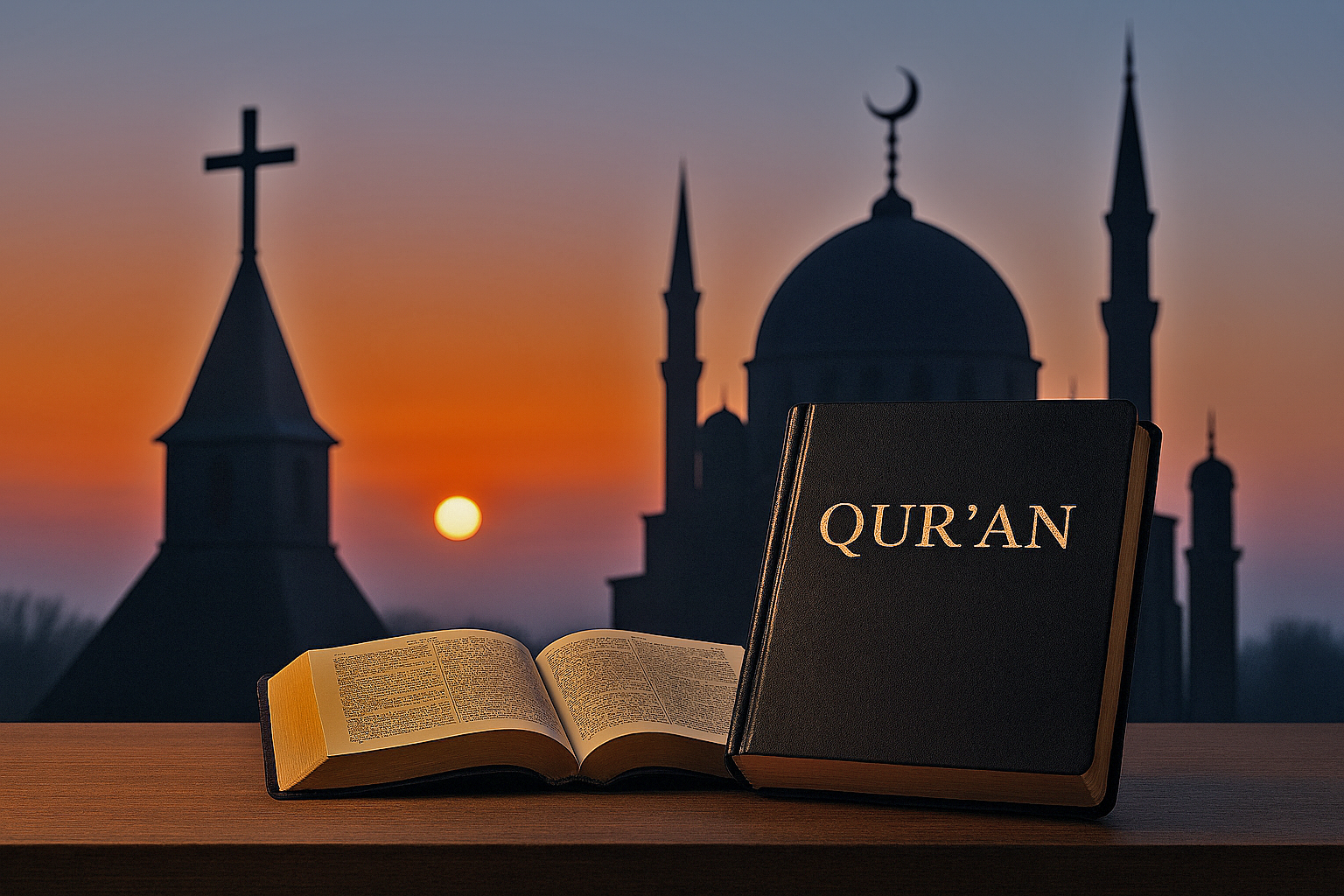
The vivid images of looming, crescent-mooned spires, masked women, exotic Arabic calligraphy, and headlines of radical Islamist activity can cause interest or even fear in those that find themselves outside of the Muslim faith. But Christians may be surprised to know that Muslims appeal to arguments for inspiration that are similar to those used by Christians. Many world religions claim to have an inspired word from God. What are the criteria by which someone can know that he has the true Word of God in his hands? It is important to analyze the differences between Christianity and Islam to understand what is at the heart of Qur’anic claims to inspiration.
Evidence from the Qur’an and Islamic scholarship leads to various conclusions about the inspiration of the Qur’an:
- The final revelation from God is the Qur’an in Arabic as revealed by the angel Gabriel to the Prophet Muhammad and recited orally to his Companions (Qur’an surahs 2.23, 2.285, 10.94, 2.97, 39.41, 64.8, 76.23).
- The “challenge verses” in the Qur’an communicate that the Qur’an is so unique in style and content that no one can produce a writing like it (the Islamic doctrine of inimitability) (Qur’an surahs 2.23, 10.38, 11.13, 17.88, 28.49, and 52.33-34).
- This revelation was either created by Allah or coeternal with him in the Arabic tongue, so translations of the Qur’an are not truly holy Scripture (Qur’an surahs 43.4, 85.21, 13.39).
- God also revealed truth through the Judeo-Christian Scriptures in the Bible, but Jews and Christians have distorted understanding of these Scriptures (Qur’an surahs 2.42, 2.146, 2.69, 64.4, 2.79, and 3.78).
- Like biblical scholars, Muslim scholars make the appeal for inerrancy of the Qur’an as a deductive argument from the doctrine of inspiration and the nature of God.
Upon studying the Muslim doctrines of revelation, several contrasts with the biblical view of inspiration surface.
First, in contrast to the oral transmission of the Qur’an – and contrary to views of some liberal biblical scholars – the revelation of the Bible was not dependent on oral transmission and the memory of man but rather on written records. Muslims hold to Allah’s perfect preservation of the Qur’an (surah 15.9) as it was recited by Muhammad and then as his followers committed the words to writing and then destroyed all other existing manuscripts at that time. An unbroken set of manuscripts going back to Muhammad is untenable according to qur’anic scholars.
The human writers of the Old and New Testaments wrote God’s words in common human languages as they were “carried along by the Holy Spirit” (2 Pet 1:20–21). Thus, inspiration applies solely to the autographs of the Scriptures, not to the human writers themselves. In addition, scriptural authority is not limited to one language such as the Qur’an’s Arabic.
Erickson explains that “here Peter is affirming that the prophecies of the Old Testament were not of human origin. Rather the writers were moved or borne along (φερόμενοι—pheromenoi) by the Spirit of God. The impetus that led to the writing was from the Holy Spirit.” The Jews at this time considered “the Law of Moses, the Prophets, and the Psalms” as the Scriptures under the Mosaic Covenant (Luke 24:44–45). God breathed out the OT Scriptures, and the Scripture writers were aware of this work of God as they were writing (Mic 4:4; Amos 3:1; Acts 3:18–21; 2 Sam 23:2). This mode of inspiration contrasts with the dreamlike cave appearances of the Angel Gabriel to Muhammad through which he received the recitations of the Qur’anic surahs.
Peter refers to the writings of Paul as Scripture, and John and Paul are conscious of divine authority in their writings (1 John 4:6; Rev 22:18–19; 1 Thess 1:5; 2:13). The Old and New Testaments teach that the written component of the Scriptures of both Testaments is of the utmost importance as adding or taking away from the words of Scripture comes with a great warning (Rev 22:18–19; cf. Matt 5:18). While an unbroken chain of manuscript tradition going back to Muhammad for the Qur’an is unavailable, the overwhelming amount of biblical manuscripts provide what is needed to reconstruct the original biblical text.
Second, in contrast to the Qur’anic doctrine of inimitability, the Christian Scriptures often appeal to the fulfillment of prophecy and the performing of miracles (1 Kgs. 22:12-35; Deut. 13:1-2), rather than the irreproducibility of the exact style of the literature, as proof of God’s revelation. The predictions of the OT consistently come to pass. For example, Joseph predicted that his bones would be carried out of Egypt (Gen. 50:25; cf. Exod. 13:19), the prophets predicted that Babylon would take Israel into exile (1 Kgs 14:15; Isa. 39:7), and, most notably, many passages anticipated the coming of the Messiah and were fulfilled in Jesus Christ (Matt. 8:17 and Ps. 22:18; Jn. 12:38 and Isa. 53:1).
Muslims take the prophecy of Moses that a final prophet would come and see its fulfillment in the Prophet Muhammad. Taking the storyline and teaching of the OT in context (Deut. 18:15, 18; cf. Acts 3:22; 7:37), Jesus more clearly fulfills this prophecy as he is from the line of Israel (not of Ishmael like Muhammad) and has also fulfilled the law of Moses (cf. Matt 5:17).
Muhammad can make no such claim to fulfillment concerning the law nor the additional claim of Jesus Christ to the Davidic throne (Matt 1:1–17; Acts 2:30). In addition, the miracles of the Old and New Testament prophets and Jesus Christ himself serve as further proof of the revelation they received from God. Moses’ signs during the time of the exodus and wilderness wanderings served to validate God’s authority and words given through Moses (Deut 4:34–35). The power and authority of Jesus were recognized by the Jews as so powerful that two of the Gospels give testimony that he was confused with the OT prophet Elijah, known for some of the greatest “signs and wonders” of the OT outside of Moses (Matt 16:14; Mark 8:28).
The miracles as tangible proofs of the message of prophecy stand in great contrast with the only claim the Qur’an makes concerning its message, that the writing is just “inimitable.” Not being able to be imitated pales in comparison with the proofs put forward in the Judeo-Christian Scriptures of the historical predictions that are verifiable in history and the revelations followed by signs and wonders.
Finally, in contrast with the doctrine of coeternality of the Qur’an, Christians believe that Christ is the final revelation of God the Father and the Word of God, himself coeternal with the Father (Col 1:13–17, 19), but the written word about him, the Christian Scriptures, are not coeternal with the Godhead.
Rather, the entirety of the Scriptures serves to reveal the eternal Son of God, Jesus Christ. Jesus explained as much in a resurrection appearance to the two disciples who were disheartened after his death (Luke 24:27; cf. John 5:39–40, 46). Christ is said to be the Word of God himself (John 1:1–8) indicating further that the purpose of the Scriptures is to speak of him and his salvation to the world.
The OT prophesies of him and explains the history of his people up until his coming. The NT Gospels manifest him, Acts proclaims him, the epistles explain him, and John’s Revelation reveals the consummation of his plan and person.
As shown previously, while the Qur’an respects the Bible and its prophets as revelation from God, the Qur’an systematically accuses the Christians of distorting the meaning of the Old and New Testament Scriptures to “associate” Jesus Christ with God. If, however, the Scriptures do not point to Jesus’ identity as God and the Messiah he has sent, then the Bible is not about much at all since this theme appears to be the main point. Neither can the Bible be considered a conspiracy to institute Jesus-worship as the Old and New Testament Scriptures were written by up to forty different authors over some 1,500 years.
These aspects considered, rather than being an original revelation of truth, the claims of the Qur’an about the Christian Scriptures appear to be a systematic effort to deny the truth about God, Christ, and divine revelation.
The Bible presents mankind with a fundamentally different religious idea than the works-based religions of the world, including Islam. The library of the two Testaments testifies of its divine inspiration to tell the story of the salvation of mankind through the Messiah and Son of God, Jesus Christ. The manuscript tradition presents a remarkable wealth of knowledge to reconstruct the original text and faithfully communicate a record of the message of the original. The fact that a large portion of the Qur’an deals with a reinterpretation of the pre-Islamic Scriptures and lacks evidence to prove the corruption of the Christian Scriptures seems to indicate that perhaps the Qur’an is the source “concealing” the truth of the earlier revelation.
Has God spoken through Muhammad? Muhammad may claim to have spoken on God’s behalf, but that does not mean he spoke at God’s request. God has spoken in these last days through his Son, Jesus Christ.